 @ GS칼텍스
2024Full-Stack
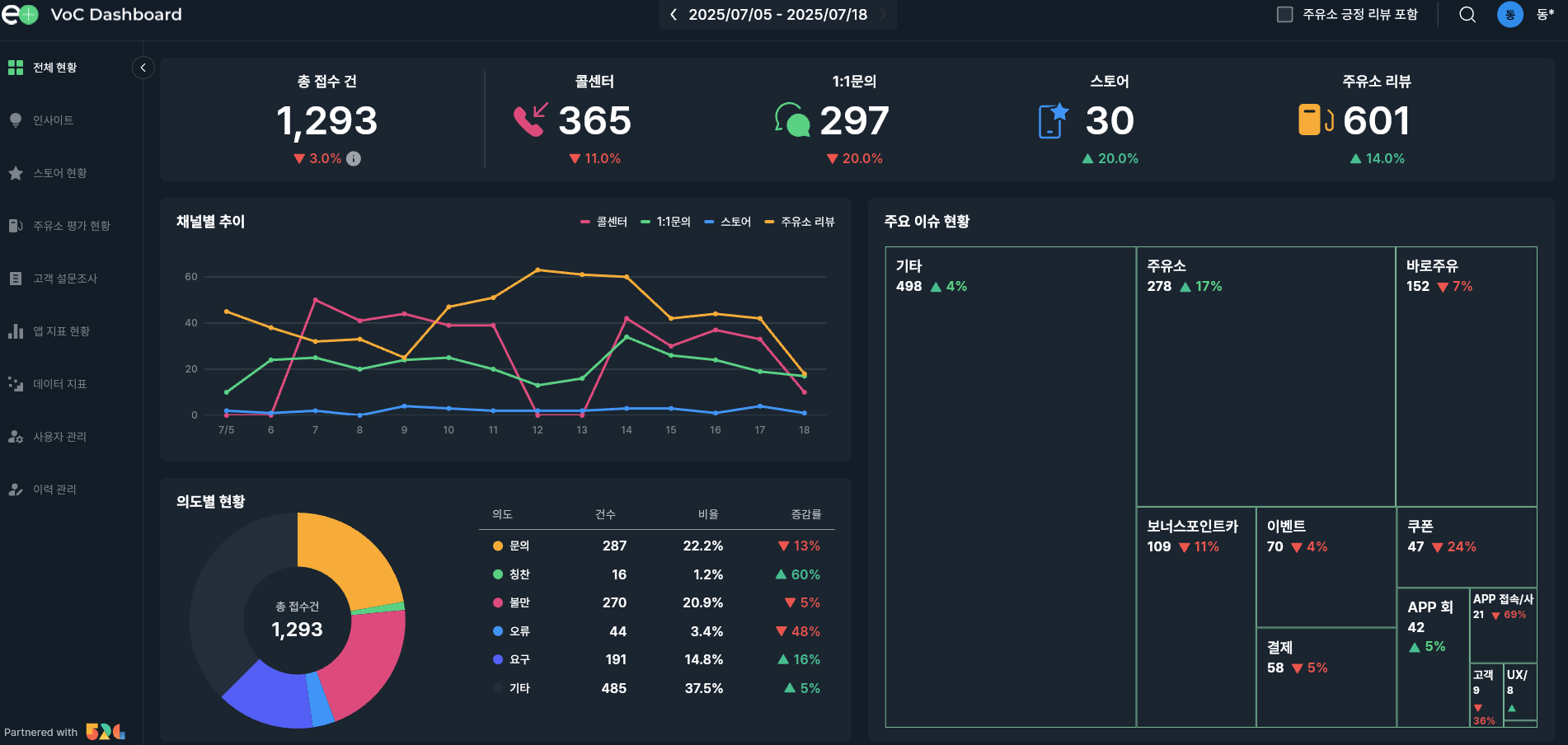
GS Caltex VOC AI Dashboard
Sole architect and engineer of the VOC AI Dashboard, manual review replaced by 1,000+/day auto-classification across 4 integrated channels.
View details
On a non-developer self-run environment a 6-person team built on top of open-source Dify, I owned two axes — the org-mapped permission model and the non-developer training.
Marketing, HR, customer service — all wanted to use AI. The entry barrier, permission management, and IT-team dependency stopped every attempt.
"I want to use AI but I have to wait for IT's calendar." That line repeated across teams. Even when a tool got built, change requests never ended, and IT could not carry every team's asks.
The domain lived with the team that owned it. A centralized "build a tool for you" model could not reach that distance.
Outcome ▸AI adoption = IT bottleneck. Self-run by the team itself: zero.
Field notes
Tool-building never ended
Even built tools attracted endless change requests — the tool model had no closing point.
IT was the ceiling
One IT team could not absorb every team's AI ask.
The domain lived with the team
The team using the workflow understood it better than IT ever could.
Dify's default admin/user split did not match the way the company is actually structured by department, title, and role. Mapped the org chart itself into the permission model as a matrix.
tradeoffComplexity vs. accuracy — accuracy first
Knowing that installing the tool alone would not produce self-running teams, ran a training track that taught "how to build" alongside adoption. Permission tier and learning tier moved together on one track.
tradeoffLaunch speed vs. how long self-running actually lasts
AX adoption lands best when the internal heat is right — the will to solve with AI plus environmental support. At that moment, what stops fear-of-sprawl from producing meaningless MVPs is not technology; it is the permission model (boundary) plus training (learning path) — how you compose the organizational dynamics.
tradeoffAdoption speed vs. how long self-running lasts
Internal AI tools
~140
Employee-built (platform-wide, 2025)
Build speed
1 month → under 1 week
Professional dev → employee self-build (platform-wide)
Group-company adoption
20+
MISO platform (as of 2025)
DX leads on one workflow
230 people
Platform unified workflow (2025)
“An engineer who spotted the gaps in the company's org, language, and training context, then designed the permission model and learning path that let non-developers use AI safely on their own.”
Read the gaps in the org, language, and training context as a pattern.
Designed the RBAC mapped to the org chart and wrote the non-developer training and ops playbook — permission tier and learning tier kept on a single track.
Platform-level change that landed on top of permissions and training — about 140 employee-built tools, cycle time from one month to one week, 20+ group companies adopting (as of 2025).
More work