 @ 스타트업
2024Full-Stack
Copykle AI Marketing Solution
"You shouldn't have to know how to talk to an AI." The moment a user feels they're writing a prompt, the product has failed.
View details
Eight months of moving one domain fact — that a guardian, a facility, and a caregiver stand behind one senior — into the backend model.
It was a senior-care service, so I assumed I only had to design the senior-user experience well. The backend was sketched on top of that — one user signs up, logs in, receives the service, sees the notifications. One single-user model looked like it would be enough.
The reality of building the service was different. The person paying and the person matching a caregiver were both the guardian; the person receiving the service was the senior; the person performing the care was the caregiver at the facility. Paying, matching, receiving, and performing were spread across four different people, and the single-user assumption did not fit anywhere.
Field notes
One senior, three people
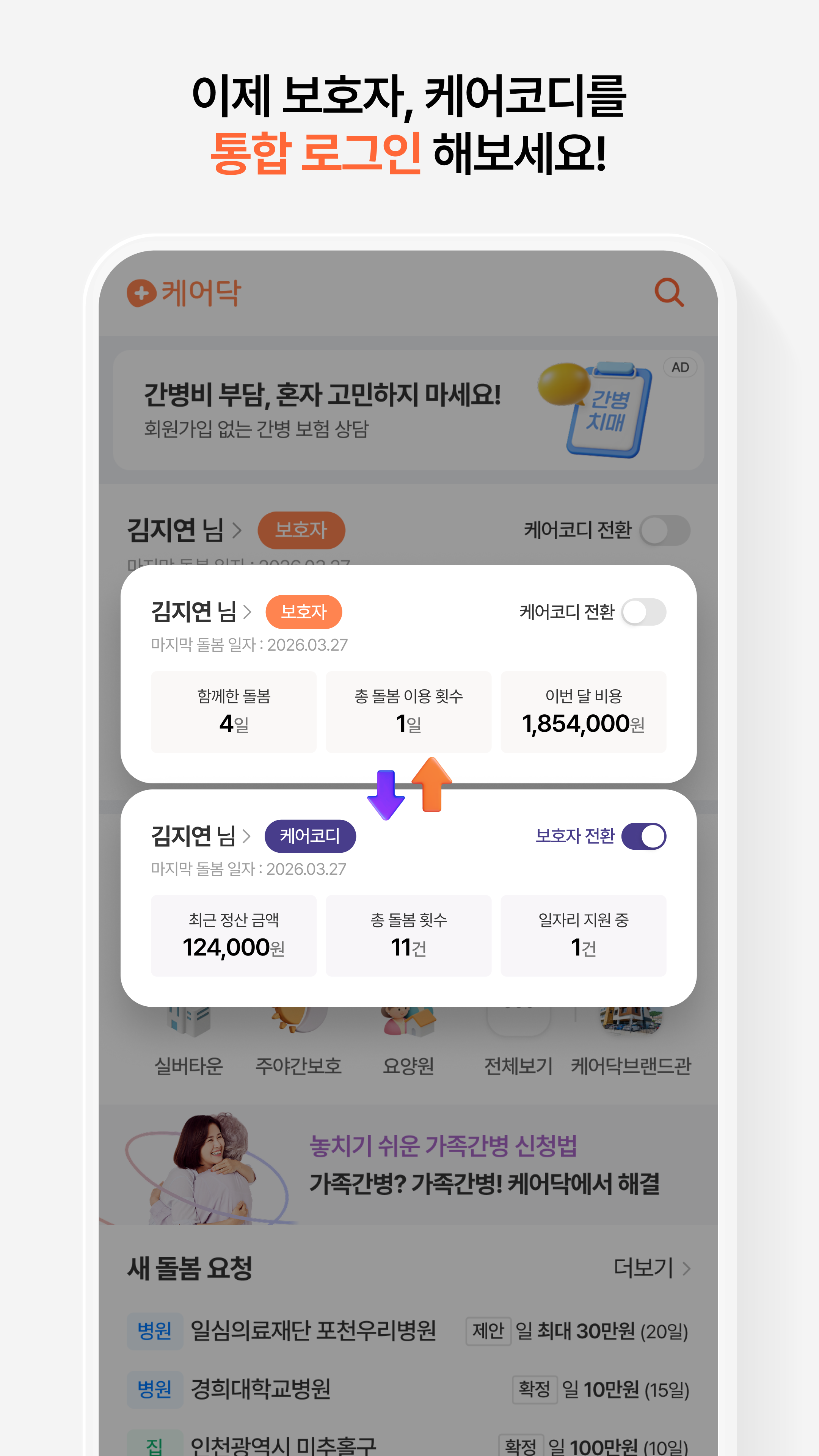
Guardian, facility, and the senior themselves all read the same data at once — this was not a "one person, one screen" model.
Permissions attach to the role, not the user
Billing rights, view rights, and admin rights were distributed differently across the three seats.
Paying, matching, and receiving were three different people
The guardian both paid and matched the caregiver; the person receiving the service was the senior.
Attaching permissions to the user could not hold the fact that guardian, facility, and senior each have different rights. Attached permissions to the *role* instead, and redrew the model so a single senior's data can be reached from three seats with three different views. The Node.js → Spring Boot 3.x rebuild was the exact moment to absorb that redefinition.
tradeoffImplementation complexity vs. domain accuracy
The real flow: the guardian paid, the guardian matched the caregiver, and the senior was the one receiving the service. The domain did not work if one user did all three. Bundled billing and matching rights onto the guardian role and separated the recipient (the senior) from the billing and matching screens — composed entirely different data views for each.
tradeoffA simple user model vs. the domain fact as it actually is
Spring Boot 3.x migration
8 months
Node.js → Java/Spring — the seat where permissions, billing, and matching were redefined
3 months post-launch
10k downloads
Team result
User satisfaction
4.5 / 5.0
Team result — absorbed the permission, billing, and matching incidents that hit in ops
“Eight months of moving domain facts into the backend model — making room inside it for the three people standing behind a single senior.”
Surfaced the domain fact that behind a single senior, the guardian, the facility, and the caregiver each read the same data differently.
Redefined the domain model on top of the single-user table: permissions belong to roles, not to users.
During the Node.js → Spring Boot 3.x rebuild, redesigned the permissions matrix and split billing from matching in the same eight-month push.
10k downloads and 4.5 satisfaction within three months post-launch (team result) — the new model absorbed the permission, billing, and matching incidents that came up in ops.
What happens when product, design, dev, and ops all run through one pair of hands.


More work